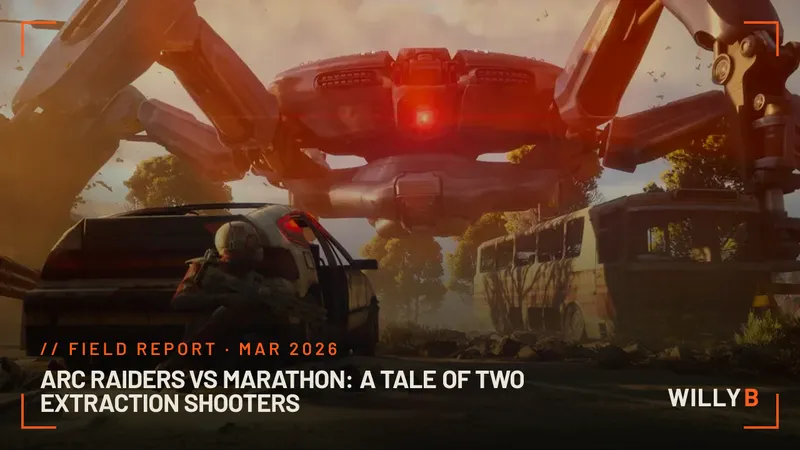
If a bit of PvP does not put you off, ARC Raiders is the one I would play, and Marathon is the riskier bet, because two of the most-hyped extraction shooters of the modern era launched within a few months of each other and went in opposite directions. ARC Raiders is a runaway phenomenon, Marathon is fighting for its life, and they were chasing the same audience with similar genre foundations, which makes the reason why the single most important lesson in extraction shooters right now. The lesson is design, not budget and not pedigree, and a careful or solo player can feel the difference before the sales charts do.
What ARC Raiders did with the audience
Embark’s robot-apocalypse extraction shooter launched in late October 2025 and just kept climbing, because it sold somewhere north of fourteen million copies, with some reports pushing past sixteen million by mid-2026, peaked near a million concurrent players, and held its audience where most live-service games bleed out. Over half its players put a hundred hours or more in, it swept awards, and I covered the breakout in the ARC Raiders report. The number that actually matters there is not the sales figure, it is the retention, because anyone can buy a hyped game once, and half the player base clearing a hundred hours is a game that keeps people, which is the whole ballgame in a genre built on repeatable runs. Selling sixteen million copies is a launch, and half of them still playing months later is a hit, which is the distinction I wish more of these bets understood before they shipped.
What Marathon did with the same months
Bungie’s extraction shooter had a rough closed alpha in 2025, a delay, and a relaunch in March 2026 at forty dollars, and the launch itself was respectable, around eighty-eight thousand concurrent on Steam and over a million copies sold in the first few weeks. Then it fell off a cliff, dropping to less than fifteen percent of its launch peak within weeks, and Bungie’s recovery plan leans on adding more PvE, which I broke down in the Marathon report. Marathon did not fail to sell, because a million copies and eighty-eight thousand concurrent is a launch plenty of studios would kill for, and it failed to hold, since the players came, took a look at what the game asked of them, and left. That is the exact opposite of ARC’s curve, and the two curves put side by side tell you almost everything, which is a kinder lesson than waiting to see which subreddit shouts louder.
What actually separated them
The difference is design philosophy rather than budget or studio pedigree, even though Bungie made Halo and Destiny, some of the most beloved shooters ever built, and the audience still left. ARC Raiders is readable, accessible and far less hostile to a careful or solo player, because it assumes you might be one person trying to survive and makes that fun, while Marathon went all in on competitive player versus player in a moment when a huge chunk of the audience has made it clear they want the opposite. ARC met players where they are, and Marathon asked players to be something they increasingly do not want to be, which is a hard sentence to write about a studio with that history and still the one the curves support.
That word readable is doing a lot of work, because in an extraction shooter readability is the difference between a tense encounter you can plan around and a sudden death you never saw coming, and ARC gives you enough information to make careful decisions, so a cautious player feels smart rather than cheated. Crank the PvP hostility and strip that clarity out, and the same player just feels like prey, so one design invites you to get better while the other tells you to get good or get out, and most people, quite reasonably, get out. Bungie clearly agrees, because the whole recovery plan is built on adding the exact thing ARC had from the start, more room for players who are not there to sweat, and I am interested in whether they mean it once the patch is in my hands rather than in a plan.
Which one I would tell you to load
For this channel’s audience, neither is a pure PvE game, so if you want zero player threat, look at Gray Zone Warfare or Incursion instead, and if a bit of PvP does not put you off and you want the genre’s most polished, most welcoming entry, ARC Raiders is the clear pick. It is the better game, it is the healthier game, and a careful solo player can genuinely enjoy it, while Marathon is the more competitive, more demanding option, and right now it is the riskier one to invest your time in given its struggles. It may claw its way back on the strength of the PvE pivot, and if it does I will say so, while a recovery plan on faith is a purchase I will not ask you to make.
The bigger takeaway is the one I keep hammering, because accessibility and solo-friendliness are where the growth is in this genre rather than a weakness you apologise for, which ARC Raiders proved and Marathon proves by counter-example. Two similar games, two opposite bets, and the market has already told us which bet it rewards, so for the games building properly for solo and PvE players, see the state of solo PvE extraction shooters in 2026, and let the matcher find your fit.
FAQ
Should I play ARC Raiders or Marathon?
If a bit of PvP does not put you off and you want the genre's most polished, welcoming entry, ARC Raiders is the clear pick, and a careful solo player can genuinely enjoy it. Marathon is the more competitive, demanding option and currently the riskier one to invest time in given its struggles, so I would not ask you to buy a recovery plan on faith.
Why did ARC Raiders succeed where Marathon struggled?
Design philosophy, not budget or studio pedigree, because ARC Raiders is readable, accessible and friendly to careful or solo players, while Marathon went all in on competitive PvP when much of the audience wanted the opposite. One of them assumes you might be one person trying to survive, and the other asked players to be something they increasingly do not want to be.
Are ARC Raiders or Marathon pure PvE games?
Neither is a pure PvE game, so if you want zero player threat I would look at Gray Zone Warfare or Incursion instead, which is the cleaner line than pretending either of these two will keep other players out of the raid. I still have a pick between them, and it depends on whether a bit of PvP puts you off before you have even loaded in.
How well did ARC Raiders sell?
Extremely well, because Embark's robot-apocalypse extraction shooter launched in late October 2025 and sold north of fourteen million copies, with some reports pushing past sixteen million by mid-2026 and over half its players putting in a hundred hours or more. It also peaked near a million concurrent and held an audience where most live-service games bleed out, which is the number I care about more than the launch week.
What went wrong with Marathon?
It relaunched in March 2026 at forty dollars to a respectable start, around eighty-eight thousand concurrent on Steam and over a million copies in the first few weeks, then fell off a cliff, dropping to less than fifteen percent of its launch peak within weeks. Bungie's recovery plan leans on adding more PvE, which is the studio agreeing with the curve after the players had already left.
Can a solo player enjoy ARC Raiders?
Yes, it is readable, accessible and far less hostile to a careful or solo player, because it assumes you might be one person trying to survive and makes that fun, which is exactly why it succeeded where Marathon struggled. I would still not call it a pure PvE game, and a careful player can have a good night in it without being told to get good or get out.
Sources (2)
More like this
 Field report
Is Arc Raiders too casual? Tarkov's boss thinks so
No, Arc Raiders is not too casual, even though Battlestate's Nikita Buyanov called it an extraction shooter for casual people and wants Fragmentary Order, his next game, to be the opposite. The quote is spiky, and it still maps the split, because one lane wants the pain and the other kept the tension while lowering the punishment.21 Jun 2026Read Field report
Marathon Player Count 2026: Is Bungie's Game Recovering?
Marathon sits somewhere between a recovery and a rented crowd, because Season 2 and a free Open Play Week pulled the Steam peak back to around 40,000 after it had fallen to about 25,000 from a launch high of roughly 88,000. The figure that matters is the one a fortnight after that free door shuts, and the money, which reporting says is still nowhere near breaking even, is the pressure underneath.19 Jun 2026ReadNew field reports, to your inbox
No spam. Leave whenever you like.