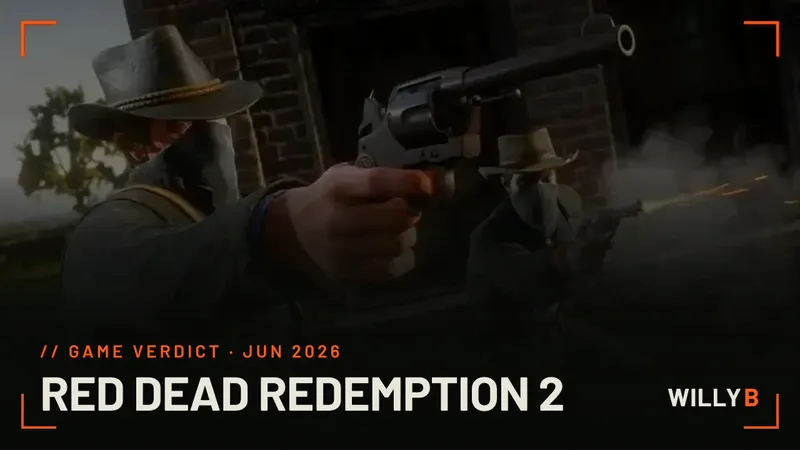
Red Dead Redemption 2 is worth it in 2026, and it is not close, which is a strange verdict from someone who came up on twitchy tactical shooters, quick swaps and fast peeks and a death every ninety seconds. I treated it like homework I kept putting off, so this is not a fanboy talking, it is the verdict from the exact player you are if you keep bouncing off slow games. The catch, and it is the whole question, is that the game is slow on purpose, and once you set it up right the slowness stops being a chore and becomes the reason it sticks.
RDR2 is slow in the way Arthur walks at a measured trot, looting a body is a full animation, your horse will not magic itself to the objective, and the opening hours are a snowbound crawl. If you go in expecting a shooter with horses, you will hate the first evening and quit, and plenty of people do, which I understand because I nearly did it myself on that snowy mountain and I am glad I did not. The trick is that the slowness is the product rather than a bug sitting in front of it, and once that clicks you stop fighting the horse and start seeing the country.
Chapter 1, which I treat as the runway
I do not mean you can literally skip Chapter 1, because you cannot, but you can reframe it before you start, and that reframe is what got me through the snow. Chapter 1 is the snowy tutorial mountain that almost everyone cites as the rough patch, linear and hand-holdy, with no real freedom, so I treat it as the loading screen for the actual game. The moment you ride down into Chapter 2 and the Horseshoe Overlook camp opens up, RDR2 stops being a corridor and becomes a place you live in. If you only judged it by the first two hours you judged the wrong game, and that is the mistake I would save you from before you quit a finished story over a tutorial.
The cinematic camera, and the cores I stopped fearing
The practical setup that made it click for me was turning on the cinematic camera when I was travelling, because you pick a destination, set the horse to follow the road, hold the cinematic button and let the game frame your own western while you actually take the world in. It sounds daft to a shooter player, and it is also the single thing that turned the long ride to the mission from dead time into the best part of the day. The slowness was never the enemy, and my refusal to look at anything was, which is a slightly embarrassing thing to admit after years of treating every journey as a loading bar.
RDR2 runs on cores, and Health, Stamina and Dead Eye each sit in a ring that slowly drains, which you top up by eating, sleeping and looking after your horse, and it is lighter than the menus make it look. Carry tinned food and a couple of provisions, eat when a core dims, and you will basically never be in trouble, so do not min-max it, because the systems exist to make you feel like a person in a world rather than to run a spreadsheet. Treat them as ambience with light upkeep and the friction disappears, which is all the survival I am willing to ask of a cowboy who already has enough to worry about.
Dead Eye is the bridge from shooter brain to cowboy brain, the slow-motion mark-targets mechanic where you tap it, paint your shots, and watch Arthur snap off a string of hits. For someone used to fast aim it is the one combat system that feels immediately familiar, and leaning on it early made every gunfight read like a tactical beat rather than a clumsy one. The shooting is never the reason to play RDR2, but Dead Eye keeps it satisfying enough that the action chapters land, which is the concession I needed before I could take the rest of the pace seriously.
What I ignore, and what the money looks like
Ignore one hundred percent completion, ignore the challenge lists nagging you to skin three of every animal, and ignore Red Dead Online entirely unless you specifically want a multiplayer time-sink, because we are here for the single-player and nothing of the story lives over there. Following the camp, the bigger side strangers and the main story is plenty, and the moment you turn RDR2 into a checklist you have imported the exact thing that makes other open worlds a chore. If you want more of that solo-first mindset, I laid it out in the best open-world games to play solo, which is the same argument I am making here with a horse in it.
On the money, this is an easy call, because as of mid-2026 the single-player routinely drops to around $15 to $20 on console sales, and PC sits in similar territory when it is discounted, which for a game this size is close to a crime. Worth flagging too, console players have been stuck on the original last-gen build, and a proper PS5 and Xbox Series next-gen upgrade has been rumoured for 2026 but, as of this writing, Rockstar has not officially released or even confirmed it. So buy on the version you have now rather than waiting on a port that may or may not land, since the story is already finished and the discount is already the one I would take.
Nothing left to wait for, which is the reassuring part
Rockstar confirmed years ago it has no plans for single-player story DLC, and none ever came, so what you buy is the complete, finished story, with no season pass, no drip-fed chapters, and no FOMO, because nothing else is coming. That is the one thing that should reassure a shooter player on the fence, because there is nothing to wait for and the whole thing is sitting there on sale. Yes, and it is not close, since RDR2 is the rare open-world game where the slowness is the point, and a tactical-shooter player can cross over if the cinematic camera is on, Chapter 1 is treated as a runway, the survival stays light, completion is ignored, and Dead Eye is leaned on.
It asks you to change gear rather than mash the throttle, and that is exactly why it sticks, so if you want the wider buying context, poke around the Red Dead Redemption 2 hub or the rest of the intel desk, then go and tell me whether you made it off that snowy mountain. I nearly did not, and I am glad I did, which is the whole of the verdict once the setup is out of the way.
FAQ
Is Red Dead Redemption 2 worth it in 2026?
Yes, for the single-player, because it is one of the best open-world games ever made and routinely drops to around $15 to $20 on sale, though the pacing is slow on purpose. If you set it up right, with the cinematic camera on and some patience through Chapter 1, the slowness becomes the appeal rather than a chore.
Is Red Dead Redemption 2 too slow to enjoy?
Chapter 1 is a slow, snowy tutorial that most players cite as the rough patch, so push through it, and once the camp opens up in Chapter 2 the game becomes a world you live in rather than a checklist, because the deliberate pace is the whole point. If you only ever want twitch action it is not for you, but most shooter players adapt within a few hours, which is what happened to me after I stopped treating the trot as a fault.
Is there any single-player DLC for Red Dead Redemption 2?
No, Rockstar confirmed it has no plans for single-player story DLC and never delivered any, focusing entirely on Red Dead Online, so what you buy is the complete story with nothing extra to wait for. That is the reassuring part for a shooter player on the fence, because there is no season pass and no drip-fed chapter still sitting in a vault.
How much does Red Dead Redemption 2 cost in 2026?
On the money it is an easy call, because as of mid-2026 the single-player routinely drops to around 15 to 20 dollars on console sales, and PC sits in similar territory when discounted. For a game this size that is close to a crime, and I would buy the copy that is in front of you rather than wait on a port.
Is there a PS5 or Xbox Series next-gen version of Red Dead Redemption 2?
Not yet, because console players have been stuck on the original last-gen build, and a proper next-gen upgrade has been rumoured for 2026 but, as of this writing, Rockstar has not officially released or even confirmed it. Buy on the version you have now rather than waiting, since the story you are paying for is already the finished one.
What is Dead Eye in Red Dead Redemption 2?
It is the slow-motion mark-targets mechanic, so you tap it, paint your shots, and watch Arthur snap off a string of hits, which for a shooter player is the one combat system that feels immediately familiar. It is the bridge from shooter brain to cowboy brain, and leaning on it early is how the action chapters stopped feeling clumsy to me.
Sources (3)
More like this
 Red Dead Redemption 2
Best Games Like Red Dead Redemption 2: What to Play After Arthur's Story
Nothing is exactly like Red Dead Redemption 2, and the closest single match I have played is Days Gone, with Ghost Recon Wildlands for the living wilderness, Cyberpunk 2077 for the story, Mad Max for the lonely brooding, and GTA 5 for the Rockstar sandbox. I have put serious hours into all five on the channel, and I would hand you one of them after Arthur's credits rather than sit on my hands until 19 November 2026.16 Jul 2026Read Red Dead Redemption 2
Is Red Dead Redemption 2 Crossplay or Cross-Platform in 2026?
No, Red Dead Redemption 2 has no crossplay and no cross-progression in 2026, so PlayStation matches PlayStation, Xbox matches Xbox, and PC sits on its own while a move between them starts you from zero. PS4 and PS5 share servers, and so do Xbox One and Series, which is cross-generation rather than crossplay, and I would buy on the platform your crew already rides.9 Mar 2026ReadNew field reports, to your inbox
No spam. Leave whenever you like.